I’ll never forget the look on Shaw’s face.
We were on the floor together. He was four or five, building something with blocks. But my phone kept buzzing. Emails. Notifications. I kept checking, kept responding, kept telling myself I was multitasking.
When I finally looked up, I saw it: resignation. Not anger or sadness. Just the quiet acceptance that he’d already learned not to expect my full attention.
That moment gutted me because I wasn’t in an office across town. I wasn’t traveling for work. I was right there on the floor next to him, physically closer than most working parents ever get to be.
And somehow, that made it worse.
The Paradox of Proximity
This is what I call the Paradox of Proximity: You work from home specifically to be present for your family, but being physically available while running a business means you’re mentally absent during the moments that actually matter.
You’re there for breakfast, thinking about your client call.
You’re at the park, replying to emails.
You’re playing blocks, building nothing either of you will remember.
Traditional working parents miss moments because they’re not home. Remote working parents miss them while sitting right there. The proximity makes the absence more painful, not less.
Fifteen Years of Looking for the Wrong Answer
For fifteen years after the 2008 crash, I thought I just needed to find the right business model.
From 2009 to 2018, I cycled through failed ventures: Information publishing lasted nine months before I quit. Forex trading made it seven months. Dropshipping, six months. Amazon FBA, another seven.
Each time, I convinced myself THIS would give me freedom to be present with Shaw.
Each time, I quit before it had a chance to work.
Then in 2018, I started my digital marketing agency. It survived, but I still struggled. Through Covid and beyond, I was still checking emails during dinner, still mentally absent during playtime.
The business was working, but the systems weren’t.
Not because the models were wrong, but because I was asking the wrong question entirely.
I kept searching for the perfect business model when what I needed was sustainable systems first.
You can’t build freedom when you’re drowning in survival mode. You can’t focus on being present when every hour not working feels like financial suicide.
The real path isn’t business-first. It’s sustainable income, then systems that protect it, then automation that scales it. In that order.
What Finally Changed
Everything shifted when three things converged:
- Work I actually enjoyed. Content creation and local SEO weren’t just money-makers; the work itself was satisfying.
- Hayley’s unwavering support. Despite fifteen years of struggles and mounting debt, she still believed.
- Shaw’s purpose. Being a father changed everything; it wasn’t about proving myself anymore.
That combination created the foundation. But it required something I’d been resisting since my rugby career ended: building systems instead of relying on willpower.
Systems Beat Willpower
In rugby, I learned this the hard way: train harder, rest less, push through exhaustion. The result? Declining performance, constant injury, eventually a detached bicep that ended everything.
The pattern was identical in business. More effort, less rest, wondering why success kept slipping away.
Willpower fails when you’re exhausted. Systems work even when you’re tired.
The Eight Systems That Fixed Everything
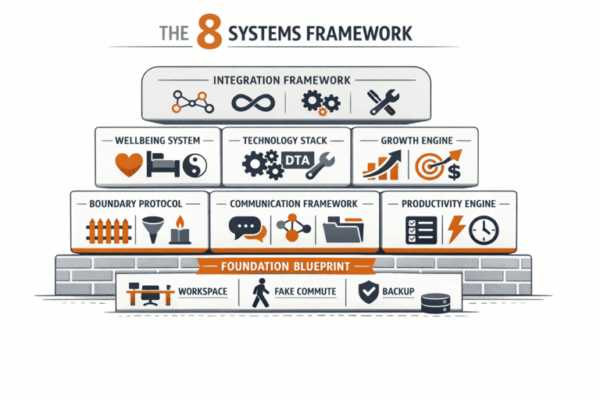
After fifteen years of struggle, I built eight practical systems that let me run a sustainable business while actually being present for my family:
- Foundation Blueprint. Command center for efficient work
- Productivity Engine. Energy management over longer hours
- Communication Framework. Connected without constant availability
- Boundary Protocol. Separates work and life in shared spaces
- Wellbeing System. Sustains energy instead of burning it
- Technology Stack. Automates repetitive work
- Growth Engine. Builds income without empire-building
- Integration Framework. Makes systems work together
Each system emerged from failure, frustration, and that look on Shaw’s face when he realized I wasn’t really there.
The Window Is Closing
Shaw is eleven now. In a few years, he won’t ask me to come see what he built. He’ll have his own life, his own priorities.
You’re in that window right now.
Every week you stay stuck checking emails during dinner, half-listening during conversations, being there but not THERE. That’s a week you don’t get back.
The Paradox of Proximity isn’t inevitable. You can be physically close and mentally available at the same time. But it requires systems, not willpower.
Your kids won’t remember every email you answered or revenue goal you hit. They’ll remember whether you were actually present.
👉 Read the full story and get The ParentPreneur Playbook Risk-free 30-day guarantee. If these systems don’t help you be more present, get a full refund and keep the book.