I want to ask you something uncomfortable. How many times this week has your child seen your face and known, without a word, that you were not really there?
That question used to hollow me out. Because the answer, for more years than I care to admit, was: most days. I worked from home. I was physically present. And yet my son Shaw had quietly learned not to expect my full attention, even when I was sitting right there on the floor beside him. You can read more about my background here, but the short version is this: I spent 15 years (2009 to 2024) building businesses, most of them failing, all of them demanding more of me than I knew how to manage.
Hustle culture was the oxygen I breathed. And it was quietly destroying the thing I was working to protect.

The Myth Nobody Challenges
Here is the story the entrepreneur internet loves to tell: wake up earlier, work harder, build passive income, then finally have time for your family. The sequence sounds logical. It is completely wrong for most people in the early stages of building a business.
You cannot build passive income when you need active money. I proved this across four failed business attempts: information publishing (nine months), forex trading (seven months), dropshipping (six months), Amazon FBA (seven months). Each time, I needed income now. The slow, patient work of building passive streams was impossible when bills were urgent and cash was not flowing.
The real sequence is: sustainable active income first. Then systems to protect it. Then automation to scale it. This is what I discovered when the agency (launched 2018) finally gave me stable ground.
But here is the harder truth. Even with stable income, I kept hustling. Because by then, hustle was not a strategy. It was my personality. Being physically present but mentally absent had become my default.
What Being “Always On” Actually Costs
The entrepreneurship conversation frames exhaustion as dedication. I want to reframe it as a financial risk. Burnout costs more than rest. A conservative 20% cognitive decline from sustained exhaustion amounts to six hours a week of diminished output — real money, real mistakes, real opportunities missed.
But the cost that hit me hardest was not financial. It was watching my son’s face. Not anger. Not sadness. Just resignation. That specific expression of a child who has recalibrated what “Dad being home” actually means. That look is the real cost of the always-on lifestyle. And no revenue figure makes it worth it.
Survival Mode vs. Building Mode
Survival mode is reactive, exhausting, and keeps you permanently behind. Building mode is intentional, structured, and requires protected energy. Most home-working entrepreneurs operate in survival mode and call it hustle. They cannot see the difference because they are too deep inside it.
The shift to building mode requires something hustle culture actively discourages: systems over willpower. Not productivity hacks. Not morning routines. Structural systems that replace the invisible infrastructure a traditional office provided: clear start and end, physical separation, natural transitions, protected focus time.

The Alternative to Hustle
The 8 systems framework in The ParentPreneur Playbook is not a productivity system. It is a presence system. Eight interconnected structures, from workspace design to boundary protocols to growth strategy, that let you run a sustainable business while actually being mentally available for your family.
None require expensive tools. None require a team. All require the decision to stop treating relentless output as the proof of your commitment.
The full article on Substack walks through all of this in detail: the passive income myth, the survival mode trap, the hidden costs of always-on working, and exactly what the 8 systems alternative looks like in practice. Read it here.
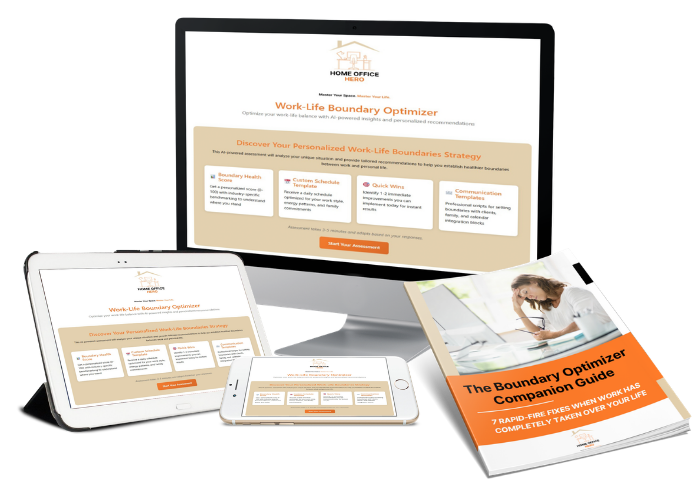
If you want to start with a quick, practical assessment of your current boundaries, the free Work-Life Boundary Assessment takes about five minutes and shows you exactly where the biggest gaps are.
Or go straight to the book. The ParentPreneur Playbook has all 8 systems, documented in full, ready to implement this week.