You chose this life so you could be around for the moments that matter. The school run. Breakfast. Being there when it counts. And yet somehow, you are always home and always at work at the same time.
That tension even has a name.
What Is a Dadpreneur?
A dadpreneur is a father who runs his own business, typically from home, while also being actively involved in raising his children. The word combines “dad” and “entrepreneur” to describe a growing group of men who are trying to build something of their own without being absent from family life in the process.
The term is not just a label. It describes a specific tension: the challenge of being a present father and a driven business owner in the same building, at the same time, every single day.
A dadpreneur might be a freelancer, a consultant, a coach, an agency owner, an e-commerce seller, a local service business owner, or any kind of solopreneur who works primarily from home. What they share is not the type of business they run. It is the environment they work in and the daily challenge of working from home as a parent while building something that lasts.
Why Being a Dadpreneur Is Harder Than It Looks
Most people assume that working from home as a dad is the best of both worlds. You get to be around your children, build your own business, and avoid the commute. And in many ways, it is a privilege.
But the reality is more complicated.
Traditional employment gives you structure by default. The office has a start time and a finish time. The commute creates a mental transition between work and home. Colleagues go home. The building closes.
When you run a business from home, none of that exists unless you deliberately create it.
Work can bleed into evenings, weekends, family dinners, and bedtime routines. The laptop is always there. The inbox never closes. A client can reach you on a Saturday morning and you will see the message before your kids are even up.
This is what makes the dadpreneur challenge genuinely difficult. It is not a lack of dedication or love for your family. It is the absence of structure, and the exhausting effort of trying to hold everything together through willpower alone.

The Paradox of Proximity
There is a concept at the heart of the dadpreneur experience that most people never put a name to.
It is called the Paradox of Proximity.
The Paradox of Proximity is the tension that occurs when a work-from-home dad is physically close to his family but mentally trapped inside the business. He is home for breakfast, for the school run, for bath time. But his attention is elsewhere. He is nodding along to a story he is not hearing. He is watching his child from behind a screen. He is present in the room but absent from the moment.
This matters because working from home does not automatically make a father more present. Without the right systems and boundaries in place, it can actually make the problem worse. The family can see that he is there. They can reach out to him. But he is not fully available, and that disconnect can quietly damage the very relationships he built his business to protect.
Recognising the Paradox of Proximity is the first step. Building systems to resolve it is the work.
If you want to understand what this looks and feels like from the inside, the Home Office Hero essay [You’re Always Home. So Why Do You Still Feel Absent?] goes into the personal story behind it. For a deeper read on the Paradox of Proximity as a concept, that article is the place to start.
What Does a Dadpreneur Actually Look Like?
There is no single type of dadpreneur. But the profile tends to be consistent.
He is typically between 30 and 50. He has one or more children, often young or school-age. He runs a business that depends heavily on him: a consultancy, a freelance practice, a small agency, a coaching business, an online service, or a local trade. He is not failing. In fact, his business is probably working.
But it costs more than he planned.
He works longer hours than he expected. He checks messages during family time. He struggles to switch off in the evenings. He feels guilty when he stops working and anxious when he keeps going. He wants to grow the business but worries that growth means sacrificing even more of what matters.
He is not lazy. He is overloaded. He is carrying the weight of provider, parent, partner and business owner. And doing it all from the same four walls.
The Core Challenges Every Dadpreneur Faces
1.No clear finish line
Without fixed office hours, the working day has no natural end point. Work expands to fill whatever time is available. Most dadpreneurs do not decide to work late. They simply never decide to stop. The boundary between work time and family time becomes blurred, and over time, both suffer.
2. The always-on client expectation
Running your own business means clients can contact you directly, and many will. Without a clear boundary protocol in place, the expectation of instant availability grows quickly. Reply to a message at 9pm once, and 9pm becomes the new normal. Clients do not ask for this deliberately. They simply adjust to whatever you teach them.
3. Guilt in both directions
The dadpreneur experiences a dual guilt that employed parents rarely face. He feels guilty when he is working because he is not fully present with his family. He feels guilty when he stops working because the business needs him. Neither state feels acceptable, and the result is a constant low-level anxiety that drains energy and makes both roles harder to perform well.
4. Willpower as the only system
Most dadpreneurs rely on intentions, mental notes, and sheer determination to manage the split between work and family. This works until they are tired, stressed, or under client pressure, which is most of the time. Willpower is not a sustainable system. It is a stopgap that fails exactly when you need it most. How that pattern repeated across a 20-year career, covering rugby and business, is worth reading if you recognise the cycle.
5. Identity blur
Without clear transitions between roles, it becomes difficult to know when you are the business owner and when you are the dad. You sit down for dinner still mentally composing a client email. You answer a work message during bath time and feel the resentment of everyone in the room, including yourself. The result is that you are never fully in either role, and both suffer for it.
Five Systems That Actually Help
The solution to the dadpreneur challenge is not more discipline, earlier mornings, or better intentions. It is better systems.
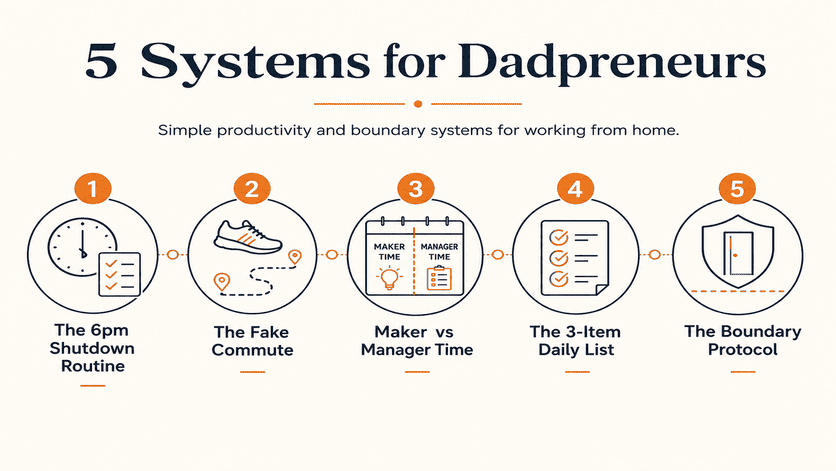
Here are five that make a practical difference.
The 6pm Shutdown Routine
The brain needs a clear signal that the working day is over. Without one, it keeps processing in the background long after the laptop closes. Which is why you can be sitting on the sofa an hour after finishing work and still feel like you are at your desk.
The 6pm Shutdown Routine is a simple 15-minute closing ritual done at the same time every working day. Write down tomorrow’s top three tasks to clear them from your head. Close every browser tab and application deliberately, not just minimise them. Say a short verbal phrase out loud, such as “shutdown complete,” to give your brain a consistent signal that work is finished. Then physically leave the workspace.
This is not about finishing everything on the list. It is about creating a repeatable off-switch that works even when you are tired and willpower has run out. For a step-by-step breakdown, read the full guide on how to switch off from work when you work from home.
The Fake Commute
The daily commute was not just wasted time. It was a mental transition between roles. When you work from home, that transition disappears and the two worlds blur together from the moment you wake up.
The Fake Commute recreates it deliberately. A 10 to 15 minute walk at the start and end of the working day gives your brain the physical movement it needs to switch context. Walk away from the house in the morning to signal that work is starting. Walk again in the evening to signal that it is done. By the time you return, you are mentally in a different mode. The specific activity matters less than doing something physical and consistent every day.
Maker Time vs Manager Time
There are two fundamentally different modes of working, and most dadpreneurs try to run both simultaneously, which means neither works well.
Maker Time is deep, focused, creative work: writing, building, designing, thinking strategically. It requires uninterrupted blocks of three to four hours and produces the work that actually moves the business forward.
Manager Time is reactive work: emails, client calls, admin, messages. It operates in short chunks and can handle interruption.
The mistake is treating every hour the same. Block your best hours, typically the morning, for Maker Time. Move all communication and admin to the afternoon. The shift in output is significant: most dadpreneurs find they produce more meaningful work in four focused morning hours than they previously managed across an entire fragmented day. For the full framework, see the dedicated guide on Maker Time vs Manager Time.
The 3-Item Daily List
Long to-do lists create the illusion of productivity while guaranteeing a feeling of failure. You start the day with fifteen items and end it with twelve still unfinished.
The 3-Item Daily List removes that cycle. Each morning, before opening email or messages, write down the three tasks that genuinely matter today. Not ten. Three. These are the non-negotiables: the work that, if completed, makes the day a success regardless of what else happens. Everything else is optional. This single change shifts the measure of a successful day from “how much did I do” to “did I do what mattered.”
The Boundary Protocol
A boundary protocol is a pre-decided, written set of rules for when you are and are not available. It answers the questions before they arise: what are your working hours? When do client messages get a response? What counts as a genuine emergency that warrants interrupting family time?
The protocol needs to be communicated explicitly to clients, to your partner, and to your children in age-appropriate terms. A boundary that exists only in your head is not a boundary. It is an intention. And intentions, as most dadpreneurs know, collapse under pressure.
Common Mistakes Dadpreneurs Make
Relying on willpower instead of systems. Good intentions are not enough when you are tired, under pressure, or facing a client demand. Systems work when willpower runs out.
Treating availability as a virtue. Responding instantly to every message trains clients to expect it. The always-available dadpreneur has no evenings, no weekends, and no mental separation between work and family.
Waiting until things settle down. The idea that you will be more present once the business is more established is one of the most common and most costly mistakes a dadpreneur makes. The business will always need more. The window with your children does not wait.
Confusing being home with being present. Sitting in the same room as your child while mentally composing an email is not presence. Physical proximity and genuine attention are not the same thing.
Skipping the transition rituals. Without deliberate start and end routines, the working day expands in both directions. Work creeps into family time. Family noise creeps into work time. Neither gets your best.
Prefer to Watch?
Here is a short video breakdown of the main idea behind this article and one practical step you can apply today.
Frequently Asked Questions
A work-from-home dad might be an employee who works remotely. A dadpreneur is specifically a father who owns and runs his own business from home. The distinction matters because business ownership brings additional pressures: client management, revenue responsibility, and the absence of any employer-imposed structure or clear finish line.
Yes, but only with the right systems in place. Without clear boundaries, shutdown routines, and productivity structures, the dadpreneur role tends toward burnout. The good news is that the same systems that protect family presence also tend to improve business performance. Better boundaries mean more focused work, not less.
The most effective dadpreneurs design their working hours around predictable family commitments rather than treating them as interruptions. The school run becomes part of the schedule, not a disruption to it. Maker Time is protected around these fixed points rather than sacrificed to them.
Guilt typically comes from the absence of a clear boundary. When your working hours are defined, communicated, and protected by a system rather than just an intention, the guilt reduces significantly. You are not stealing time from your family. You are working within a structure that was agreed in advance.
The most effective approach combines three things: clear time blocks using the Maker Time vs Manager Time split, a short daily priority list using the 3-Item Daily List, and a consistent shutdown ritual using the 6pm Shutdown Routine. These three systems work together to protect both focused work time and family presence without requiring the discipline of a professional athlete to sustain.
Yes. But not through willpower. The dadpreneurs who switch off most effectively are the ones who have designed a system that does not require willpower at all. The 6pm Shutdown Routine and the Fake Commute are two practical starting points. The ParentPreneur Playbook covers all eight systems in full.
Want the Full System?
The ParentPreneur Playbook brings together eight systems specifically built for work-from-home dads and parent entrepreneurs who want to build the business without losing the home. If the ideas in this article resonate, the Playbook gives you the complete framework to put them into practice this week.
The ParentPreneur Playbook: Finally Switch Off From Work Without Your Business Falling Behind

Read Next
- Why Working From Home Made Me a Worse Parent: the personal story behind the Paradox of Proximity and what finally changed
- The Real Cost of Hustling From Home: why the always-on approach destroys both business performance and family presence
- From Rugby Dreams to Remote Reality: how a 20-year repeating pattern was finally broken by systems, not willpower